

Netflix says AV1 now handles 30% of streaming volume
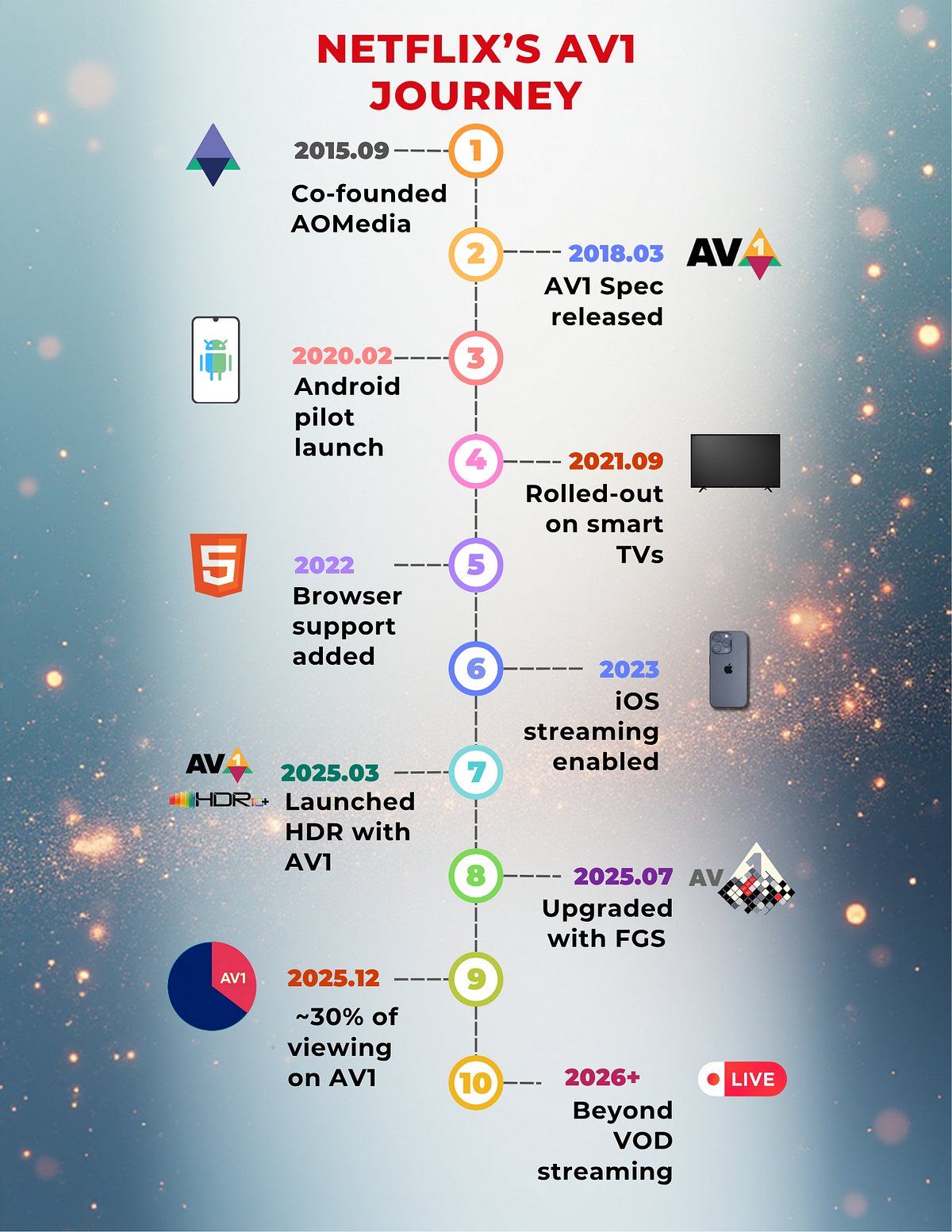
Netflix announced that AV1 now powers 30% of its streaming, making it their second most-used codec. The company highlights AV1's role in delivering higher video quality (4.3 VMAF points higher than AVC, 0.9 higher than HEVC) at lower bandwidth (one-third less than AVC/HEVC), leading to 45% fewer buffering interruptions, and driving network efficiency for its Open Connect CDN. Netflix also details AV1's use in advanced features like HDR10+ and Film Grain Synthesis, and its potential application in live streaming and cloud gaming.
Key Takeaways
- AV1 accounts for approximately 30% of all Netflix streaming and is now Netflix’s second most-used codec.
- Netflix says AV1 sessions score 4.3 VMAF points higher than AVC and 0.9 higher than HEVC on average.
- AV1 streams use one-third less bandwidth than AVC and HEVC, which Netflix says results in 45% fewer buffering interruptions.
- Netflix says AV1 with HDR10+ now covers 85% of its HDR catalog by view-hours and should reach 100% in the next couple of months.
- Netflix is evaluating AV1 for live streaming and cloud gaming, and says AV1’s layered coding could simplify live graphics overlays.
Why It Matters
Netflix has moved AV1 from a niche rollout to a material part of its delivery stack, with 30% of viewing now on the codec. That gives the company a concrete efficiency and quality lever: smaller streams, higher VMAF scores, and fewer buffering interruptions, all delivered through Open Connect. The broader signal is ecosystem adoption — Netflix says 88% of large-screen devices submitted for certification from 2021 to 2025 supported AV1, and since 2023 almost all certified devices have been AV1-capable. Watch the share of HDR catalog covered by AV1-HDR10+ as it moves from 85% toward 100%.
Read full article at netflixtechblog.com