

ST 2110 Still Wearing SDI’s 16-Channel Handcuffs
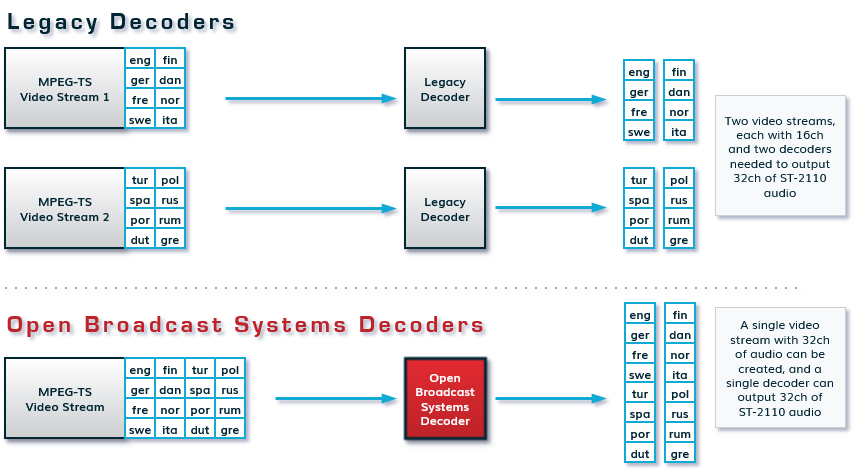
Open Broadcast Systems describes adding support for transporting and decoding more than 16 audio channels (e.g., 32 channels) within an ST 2110 IP workflow, addressing the legacy SDI-derived 16-channel limit common in many encoder/decoder designs. The post argues that many existing ST 2110 implementations retain embedded hardware constraints (DSP/CPU/FPGA resource limits), forcing workarounds like duplicating video feeds to carry additional languages. Open Broadcast Systems states its software-based low-latency encoders/decoders can handle higher channel counts without the extra video-feed approach.
Key Takeaways
- SDI’s 16-audio-channel ceiling still shows up in many ST 2110 encode/decode products due to embedded hardware constraints (DSP/CPU/FPGA limits).
- Common workaround for >16 channels: send a second video feed to carry additional audio/language tracks—doubling encoders/decoders and bandwidth.
- Open Broadcast Systems claims its software-based low-latency encoders/decoders now handle >16 channels (e.g., 32) without duplicating the video feed.
- Higher channel counts matter most for multilingual, multi-track productions where phase/alignment across separate transport streams becomes operational risk.
Why It Matters
This is a classic “IP workflow, SDI thinking” trap: ST 2110 removes the physical constraints, but product architectures often reintroduce them. For streaming operators and broadcasters scaling languages, alternate mixes, accessibility tracks, and commentary feeds, duplicating video just to move more audio is an expensive anti-pattern—more encode instances, more capacity, more points of failure, and trickier sync. The bigger narrative (and meme): the competitive edge in 2110-era facilities increasingly shifts to software-defined processing that can flex with payload complexity, not fixed-function boxes optimized for yesterday’s limits.
Read full article at obe.tv