

Netskrt's Software-Defined CDN Scales to 150 Tbps Profitably
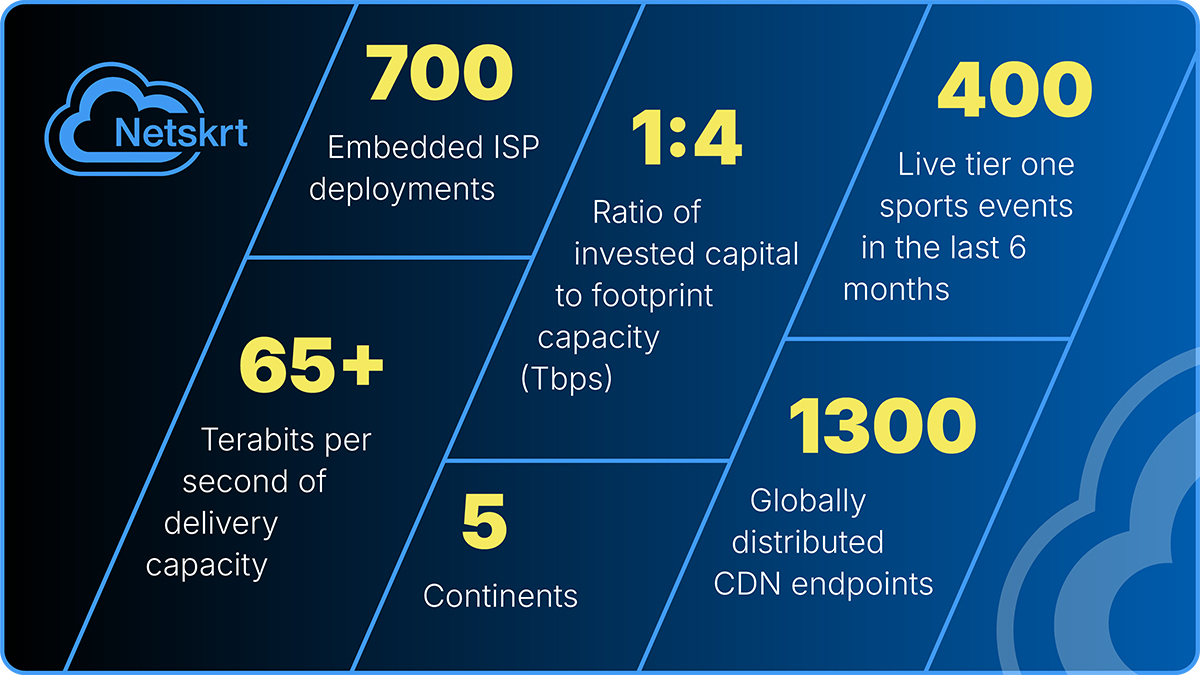
The article details how CDN provider Netskrt Systems has built a 65 Tbps software-defined CDN footprint, with roughly half its capacity embedded in last-mile ISP networks and global reach across the Americas, Europe, and parts of APAC. By relying on broadly deployed software POP instances and a stratified CapEx/OpEx infrastructure strategy, Netskrt claims it can profitably support major live events like NFL games on Prime Video and the Super Bowl on Peacock while targeting a better capital-to-revenue and capital-to-capacity ratio than traditional CDNs. The company projects reaching 150 Tbps by the end of 2026, aided by partnerships with network and bare metal providers such as Lumen.
Key Takeaways
- Current steady-state capacity: ~65 Tbps; target 150 Tbps by end of 2026.
- Software POPs enable rapid, low-capital scaling—spin up capacity in minutes to 48 hours across bare metal, VMs, containers or cloud spot instances.
- Capital efficiency: ~$30M invested with projected >1:1 capital-to-revenue and 1:4 capital-to-capacity ratios—significantly leaner than typical CDN peers.
- Roughly 50% of capacity is embedded in last-mile ISPs; partnerships with providers like Lumen accelerate geographic and capacity ramp.
Why It Matters
Netskrt’s playbook crystallizes a shift from hardware-heavy CDNs to software-first, demand-driven architectures that cut capital risk while preserving performance for sports-scale live events. For platforms and operators, that means an alternative supplier model that can undercut legacy CDNs on unit economics and react to spiky traffic without long-term iron commitments. If Netskrt hits its 150 Tbps target and the advertised ratios hold, expect pricing pressure, renewed scrutiny of CDN procurement models, and broader adoption of stratified CapEx/OpEx architectures—effectively making ‘software-defined CDN’ a table-stakes competitive narrative in streaming delivery.
Read full article at streamingmediablog.com