

LiteFrame cuts latency 35% while scaling video frames
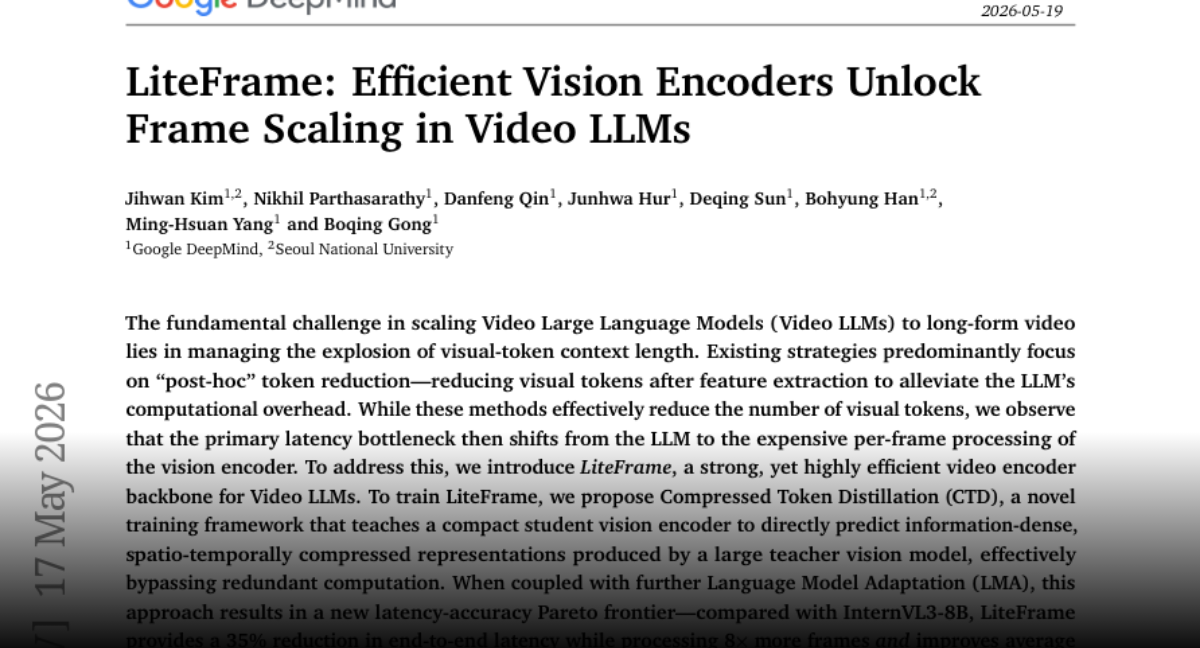
Researchers have developed LiteFrame, a lightweight video encoder designed for Video Large Language Models (Video LLMs) that reduces latency and increases frame processing capacity for long-form video understanding. The system utilizes Compressed Token Distillation (CTD) to train a compact vision encoder, achieving a 35% reduction in end-to-end latency and processing eight times more frames while maintaining accuracy compared to InternVL3-8B.
Key Takeaways
- Compressed Token Distillation trains LiteFrame to predict compressed representations from a larger teacher vision model.
- Compared with InternVL3-8B, LiteFrame reduces end-to-end latency by 35%.
- LiteFrame processes 8x more frames while maintaining accuracy on multiple benchmarks.
- The authors say the main bottleneck shifts to per-frame vision encoder processing once visual-token counts are reduced.
- Language Model Adaptation is used alongside LiteFrame to reach the reported latency-accuracy tradeoff.
Why It Matters
LiteFrame attacks a specific bottleneck in Video LLMs: once token counts are reduced, per-frame vision encoding becomes the expensive step. The paper’s 35% latency cut and 8x frame increase suggest longer-form video can be handled under tighter compute budgets without giving up accuracy. For the broader video-AI stack, that shifts attention from only compressing LLM context to making the vision encoder cheaper. What to watch next is whether the LiteFrame code and project page translate into reproducible results beyond InternVL3-8B benchmarks.
Read full article at huggingface.co