

Dolby OptiView's SGAI: Big eCPMs, Less Server Pain
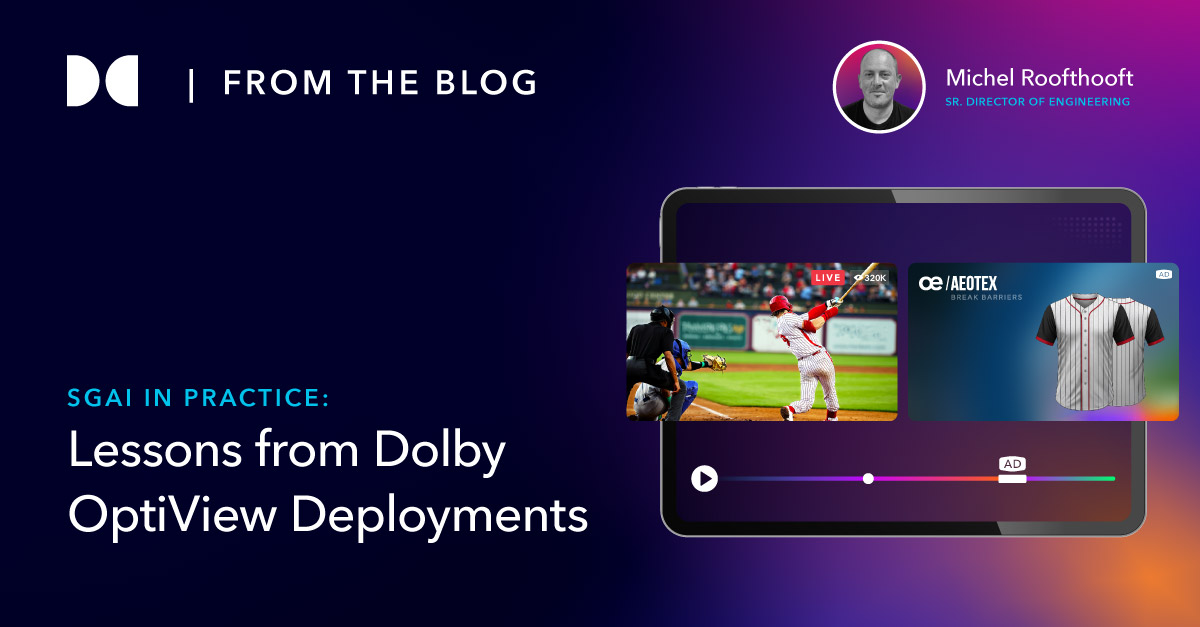
The article examines Dolby OptiView’s Server-Guided Ad Insertion (SGAI) architecture, explaining how it blends client-side and server-side ad insertion to improve personalization, latency, playback quality, measurement, and CDN scalability for live and sports streaming. It details the system’s technical design, Google Ad Manager and VAST integrations, support for advanced ad formats, and use of client-side QoE and viewability data. Case-study results from a tier-one sports deployment are cited, including higher eCPMs, better fill and programmatic match rates, and reduced server-side infrastructure burden versus traditional SSAI.
Key Takeaways
- SGAI splits responsibilities: server preconditions cacheable breaks; client performs decisioning and seamless splice, enabling CDN caching and scale.
- Real-world A/B results: +76% eCPM, +132% fill, +40% programmatic match rate, and +86% viewability accuracy versus SSAI.
- Supports low-latency workflows (broadcast ~8–10s; feasible 2–5s with extra orchestration) and advanced ad formats (L‑shapes, double‑box, overlays).
- Cuts server costs/operational risk by moving personalization to players while keeping integrations with Google Ad Manager, VAST servers, and QoE vendors.
Why It Matters
SGAI changes the economics and engineering tradeoffs of live, ad‑supported streaming. By keeping manifests anonymous and cacheable while restoring client‑level targeting and QoE measurement, publishers can scale personalization without the linear infrastructure cost of SSAI. That combination—better measurement, richer personalized formats, and lower operational risk—matters most for sports and other low‑latency, high‑value streams where synchronized playback and advertiser confidence drive CPMs. Expect vendor differentiation to center on player capabilities and orchestration, and for ad sales to repackage inventory around verified viewability and new personalized units.
Read full article at optiview.dolby.com