

Netflix’s Per-Second Index Turns Raw Footage Into Searchable Intelligence
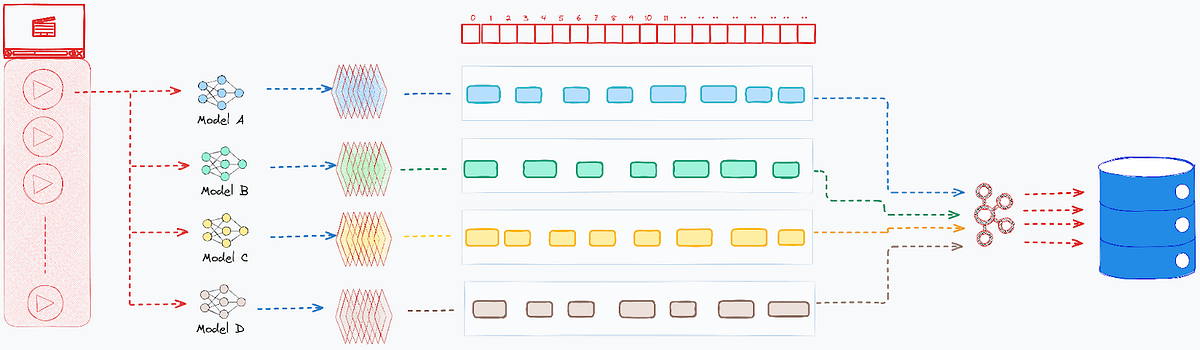
Netflix describes a production-oriented multimodal video search architecture designed to index and retrieve moments from large volumes of raw footage by fusing outputs from multiple AI models (e.g., character, scene, dialogue) into a unified, time-aligned representation. The system persists raw annotations in an internal annotation service backed by Apache Cassandra, performs offline temporal bucketing and intersection via Kafka-triggered processing, and indexes enriched per-second records into Elasticsearch to enable low-latency hybrid text+vector search and ranking. The post also outlines query planning, result deduplication/clustering, and future work including natural-language querying, adaptive ranking from user feedback, and workflow-specific personalization.
Key Takeaways
- Architecture pattern: persist raw annotations first (Cassandra), then do heavy temporal fusion asynchronously (Kafka), then index for serving (Elasticsearch).
- Key design choice: discretize heterogeneous model timelines into fixed one-second buckets to make intersections queryable at scale.
- Serving layer supports hybrid retrieval: textual queries plus vector k-NN/ANN (e.g., HNSW) with configurable similarity metrics and confidence thresholds.
- Result quality is engineered, not assumed: clustering/dedup reduces shot redundancy, and union vs. intersection logic reconstructs scene-relevant time ranges.
- Roadmap points to “search as creative co-pilot”: natural-language queries, ranking that learns from editor feedback, and workflow-specific personalization.
Why It Matters
This is Netflix quietly productizing the next battleground in streaming ops: turning terabytes of raw footage into an instantly navigable “semantic timeline.” The meme is the unsexy unlock—per-second bucketing—because it translates multimodal AI chaos into an indexable substrate that editors can actually use under deadline. Strategically, this pressures MAM and post-production vendors to offer hybrid text+vector search with strong temporal semantics and feedback-driven ranking, not just metadata tagging. For executives, the win isn’t novelty; it’s cycle-time compression in content production and marketing, where minutes saved per search compound across a slate.
Read full article at netflixtechblog.com