

Uber Advertising shifts to 'delivery media' via data and content expansion
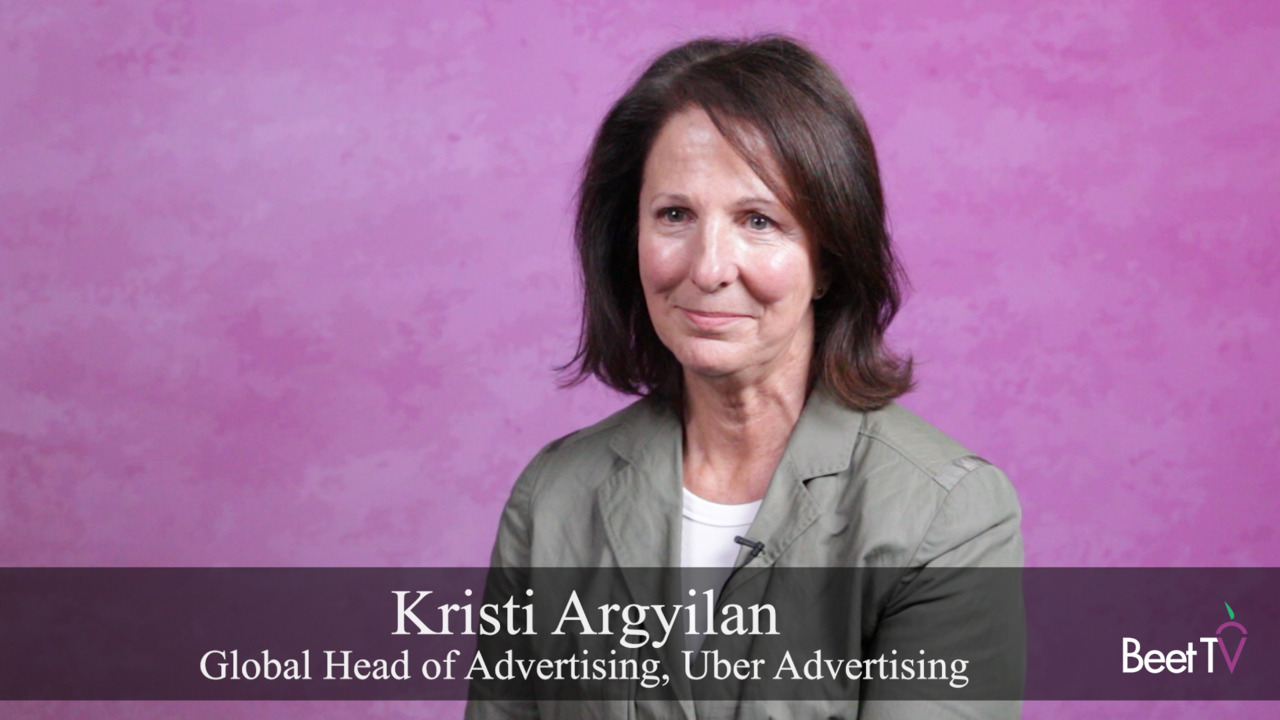
Kristi Argyilan, global head of advertising at Uber Advertising, discussed her career journey from retail media at Target and Albertsons to defining "delivery media" at Uber. Her work focuses on leveraging first-party data and contextual moments to build advertising propositions for the streaming industry. Uber Advertising recently launched new capabilities, including Uber Intelligence with LiveRamp and JourneyTV Presents with premium content partners, expanding their advertising offerings.
Key Takeaways
- Launched Uber Intelligence in partnership with LiveRamp to enable data clean rooms for secure first-party data collaboration.
- Introduced JourneyTV Presents featuring premium editorial content from partners like Time Out, Matador Network, and The Weather Channel.
- Reported a 98% ad completion rate for in-car tablets with average view times of approximately 120 seconds per ride.
- Expanded programmatic ad buying for Journey Ads to 10 European markets including Germany, Spain, and France.
Why It Matters
Uber is leveraging its unique 'delivery media' position to challenge traditional retail media by utilizing high-intent mobility signals that retailers lack. By offering a captive, high-income audience and verified 120-second attention spans, Uber provides a concrete alternative to the fragmenting Connected TV (CTV) and social media landscapes. This expansion signals a strategic shift from simple utility to a content-driven advertising ecosystem. Watch for Uber’s potential move into full-funnel measurement as it integrates offsite ad signals from Meta and Google Shopping with its internal trip data.
Additional Context
The expansion follows Uber’s record financial performance in the first quarter of 2026. Per Uber’s May 2026 earnings report, its delivery segment grew 34% year-over-year to $5.07 billion in revenue, outperforming analyst estimates. Overall advertising revenue remains a significant growth lever, with the company previously projecting a $1.5 billion annual run rate. The enterprise has continued to diversify its inventory, launching Journey Takeover in January 2026 with Coca-Cola to pair branded map displays with destination-specific creative across 12 international markets. Technologically, Uber is moving toward standardized measurement and automation. In June 2026, the company introduced new Ads APIs to allow CPG brands and agencies to manage campaigns programmatically. This maturity mirrors the broader retail media market, which eMarketer projects will reach $71.09 billion in the U.S. alone by 2026. To validate its premium in-car video claims, Uber partnered with Adelaide and Kantar in late 2025 to launch a custom attention metric, reporting that its in-ride video formats achieved attention scores 11% higher than standard tablet benchmarks. Competitive pressure in the mobility space is also intensifying. T-Mobile Advertising Solutions and its Octopus Interactive network now support Uber’s JourneyTV on more than 50,000 screens across the U.S. per a June 2024 partnership. This infrastructure allows publishers like Time Out and Minute Media to distribute content in an environment protected from the scrolling fatigue typical of mobile and social feeds. As of mid-2026, Uber’s 199 million monthly active consumers provide a scale that positions delivery media as a top-tier performance channel alongside established giants like Walmart Connect and Amazon Advertising.
Read full article at beet.tv