

MathWorks integrates Segment Anything Model 2 for advanced video processing
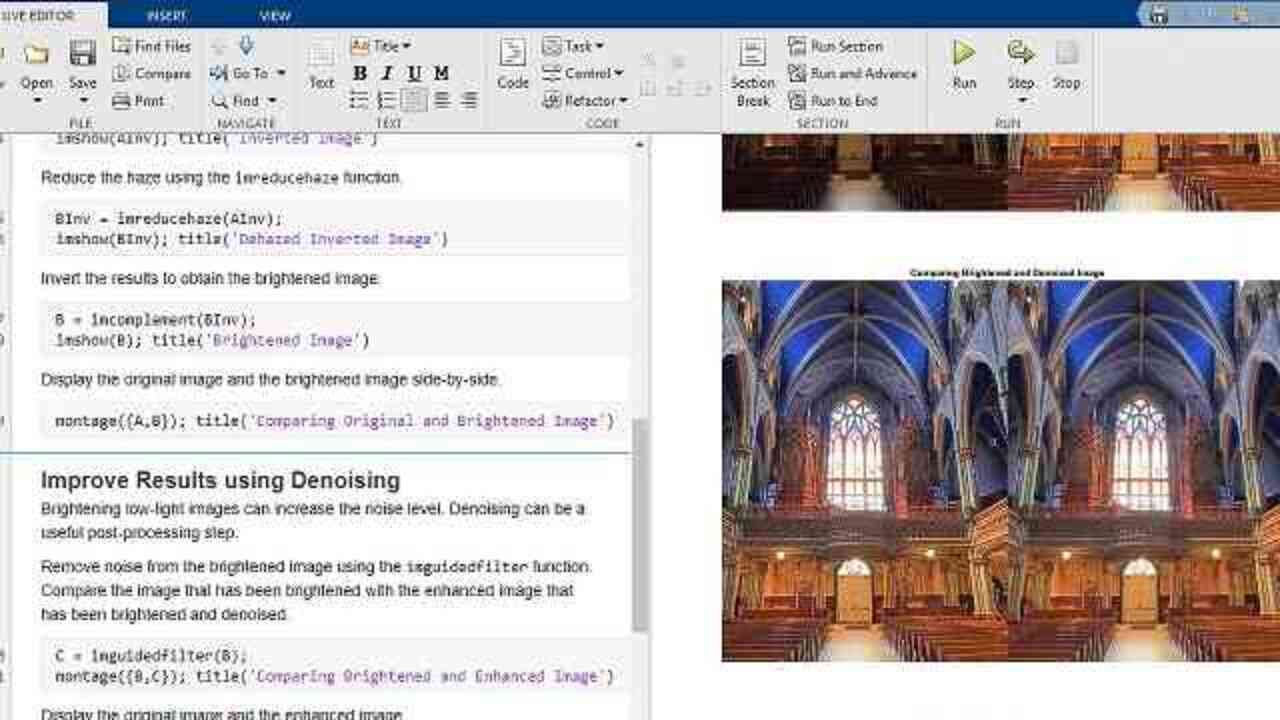
MathWorks' Image Processing Toolbox provides algorithms and apps for image processing, analysis, and visualization, supporting both deep learning and traditional techniques. It can process 2D, 3D, and large images, with capabilities such as image segmentation, enhancement, noise reduction, and geometric transformations. The toolbox also supports C/C++ code generation for embedded vision systems and GPU/multicore acceleration.
Key Takeaways
- Native support for Segment Anything Model 2 (SAM 2) enables interactive and batch-processed image segmentation without retraining.
- Toolbox now supports automated C/C++, CUDA, and HDL code generation for CPUs, GPUs, FPGAs, and ASICs.
- Integrated 3D volumetric processing includes cinematic rendering and non-rigid registration for complex visual data.
- New Hyperspectral Imaging Library adds specialized algorithms for Smile reduction and spectral indices identification.
- Enhanced low-light correction and noise reduction workflows now utilize pretrained deep neural networks for color image restoration.
Why It Matters
The integration of SAM 2 into a standard engineering environment like MATLAB signals the transition of foundation models from research experiments to production-grade streaming infrastructure. For video specialists, this provides a verified path to deploy AI-driven segmentation and object tracking directly onto hardware via CUDA and HDL. As the industry moves toward "content-aware" encoding ladders and real-time metadata generation, having these tools in a unified ecosystem reduces the friction of managing disparate Python-based AI stacks. It concretely enables faster prototyping of edge-computing applications where frame-by-frame precision is required. Watch for whether this shifts the 2026 encoding market away from generic GPU-only clusters toward more specialized VPU and ASIC-based AI pipelines.
Additional Context
The video industry is currently undergoing a structural shift toward integrating AI directly into the encoding and delivery pipeline rather than treating it as an adjacent post-processing step. Per the 2026 State of Video Encoding Report (April 2026), nearly 49% of industry professionals are now evaluating Video Processing Units (VPUs) to handle specialized AI tasks like content-aware ladder generation, which is projected to grow by 77% this year. This adoption of hardware-accelerated AI mirrors the move toward 'workload specialization' where different chip architectures are matched to specific encoding demands. Simultaneously, the production ecosystem is standardizing around a core model stack for real-time applications. According to industry analysis from Forasoft (October 2025), SAM 2 has solidified its position as the standard for few-shot segmentation, often paired with YOLO for detection and Nvidia Maxine for enhancement. This stabilization allows developers to focus on the 'systems problem' of AI—maintaining a latency budget of 5-8 ms for pre-processing to avoid dropping frames in a 60 fps stream. This context explains why MathWorks’ emphasis on automated CUDA and HDL code generation is critical; it bridges the gap between high-level AI model selection and the rigorous performance requirements of live streaming. Furthermore, recent reporting from Scientific Computing World (June 2026) highlights that MathWorks is increasingly embedding these capabilities into agentic workflows. By providing a 'MATLAB MCP Core Server,' the company is enabling AI agents to autonomously write and debug code for these video pipelines. This aligns with broader 2026 trends noted by Synamedia, where agentic AI is beginning to replace repetitive operational tasks in sports broadcasting and multi-view packaging. These developments represent a move away from manual per-frame editing toward automated, directorial-level control of video content.
Read full article at mathworks.com