

BOXX Cloud targets hyperscale giants with high-density FLEXX hardware performance
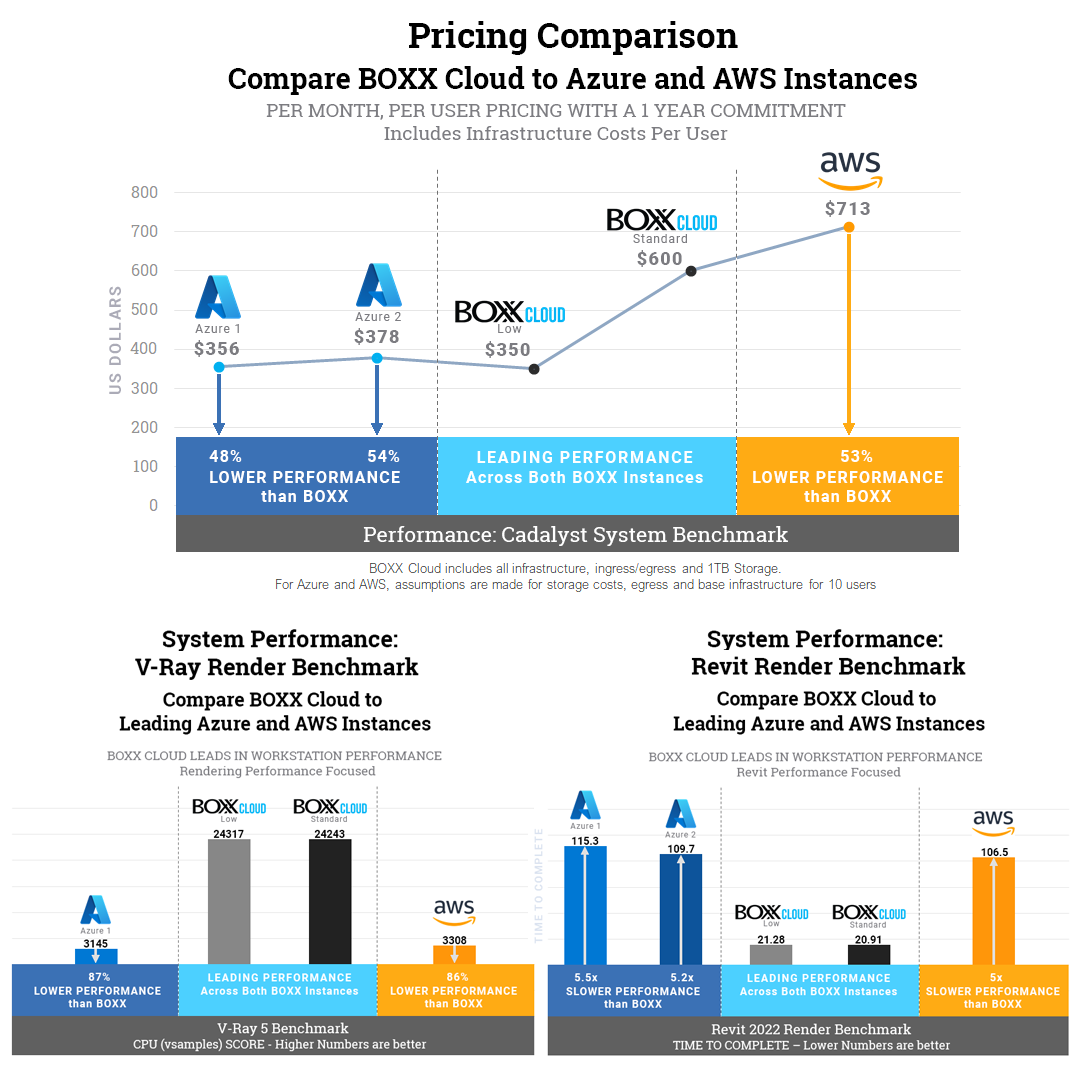
BOXX has enhanced its BOXX Cloud service, offering high-performance, remote-accessible workstations and servers designed to outperform traditional hyperscaler cloud instances for demanding professional workflows in industries like AEC and Media & Entertainment. The service leverages proprietary FLEXX hardware, which provides dedicated nodes for users without relying on virtualization, and includes managed services or on-premise hardware deployment options. BOXX Cloud aims to simplify remote computing and offer better performance and support compared to typical cloud providers, with a transparent per-instance pricing model.
Key Takeaways
- FLEXX hardware platform provides dedicated nodes in 0.5U/1U form factors, eliminating virtualization overhead for professional GPUs.
- Internal benchmarks claim 300% faster model creation in SOLIDWORKS compared to standard hyperscaler cloud instances.
- Pooling model allows firms to subscribe to modules based on simultaneous usage rather than total employee headcount.
- Integrated support for HP Anyware, NICE DCV, and Leostream ensures low-latency remote delivery and instance management.
Why It Matters
The move challenges the dominance of AWS and Azure by addressing the 'virtualization penalty' that often degrades performance in single-threaded CAD and high-end rendering workflows. For streaming and production houses, this offers a middle ground between capital-heavy on-premise builds and the high latency or bill-shock often associated with general-purpose cloud providers. By focusing on dedicated bare-metal performance, BOXX is positioning itself as a specialist alternative for high-bitrate media tasks that outpace standard virtual desktop infrastructure. Watch for hyperscalers to respond with more granular, high-frequency CPU instances to recapture these specialized engineering and production segments.
Additional Context
The push toward high-performance, non-virtualized cloud resources comes as the broader GPU cloud market undergoes significant fragmentation. Per Spheron (June 2026), specialized providers are increasingly competing on 'bare-metal' performance to avoid the 30% to 50% performance tax common in virtualized hyperscaler environments. While AWS and Azure still maintain a 2x to 4x price premium for the same silicon due to their broad enterprise ecosystems, specialist firms like CoreWeave and Lambda Labs have gained traction by offering direct access to NVIDIA H100 and B200 clusters without the complexity of traditional cloud stacks. Industry shifts in early 2026 also reflect a trend toward 'cloud repatriation,' where firms move latency-sensitive or data-heavy workloads back to hybrid or dedicated environments to avoid unpredictable egress fees and 'noisy neighbor' effects. According to Computle (December 2025), the AEC and VFX sectors are leading this transition, as standard VDI solutions often fail to meet the per-seat GPU and NVMe throughput requirements of 4K/8K production. This has led to a surge in 'workstation-as-a-service' models that prioritize dedicated CPU cycles and local-feeling latency. Furthermore, the virtualisation software market, valued at over $13 billion in 2026 per Intel Market Research, is seeing a push toward lightweight, containerized solutions to reduce the footprint of traditional hypervisors. This evolution supports BOXX's strategy of offering 'bare-metal' feel while maintaining data center manageability. As collaborative platforms like NVIDIA Omniverse become standard in professional workflows, the bottleneck has shifted from raw compute to the networking interconnects and dedicated resource availability that specific hardware platforms like FLEXX are designed to optimize.
Read full article at boxx.com