

BOXX launches high-density servers featuring NVIDIA RTX 6000 Blackwell GPUs
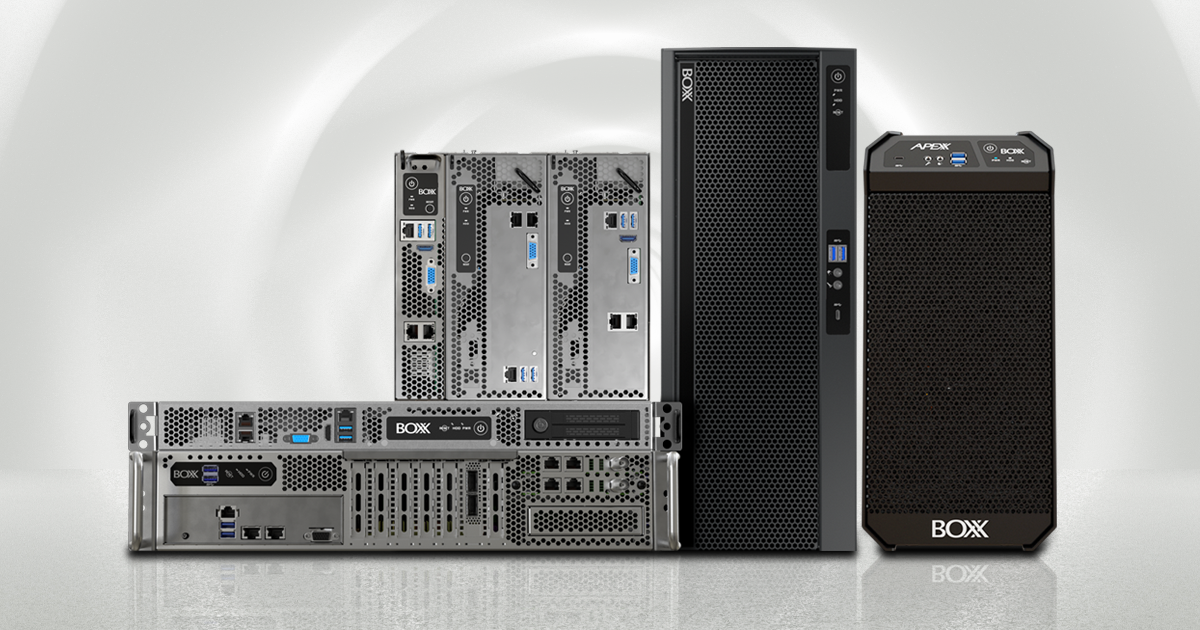
BOXX Technologies introduces new high-performance workstations and servers, including the HELIXX RTX PRO Servers and APEXX T4 PRO-X workstation, featuring NVIDIA RTX PRO 6000 Blackwell GPUs and AMD Ryzen Threadripper 9000 Series processors. These systems are designed to accelerate engineering, creative, and AI workflows for professionals in the media & entertainment industry, among others. BOXX also highlights its BOXXCloud Workstations as a Service offering and strategic partnerships with Intel, AMD, and NVIDIA.
Key Takeaways
- HELIXX RTX PRO servers utilize the new NVIDIA RTX PRO 6000 Blackwell Server Edition, supporting large-scale enterprise AI infrastructure.
- APEXX T4 PRO-X workstation scale up to quad NVIDIA RTX PRO 6000 Blackwell or quad 6000 Max-Q GPUs with a 2050W power system.
- APEXX A3 workstation, featuring the AMD Ryzen 9950K, achieved top benchmark results for SOLIDWORKS 2024 performance.
- Intel Core Ultra 200S Plus processors are now integrated across the APEXX and Creativ PC lines, offering increased core counts and faster memory.
Why It Matters
This launch signals a critical hardware refresh for the streaming and VFX sectors, providing the local compute density required for complex generative AI and neural rendering. As production cycles compress, the shift toward liquid-cooled, multi-GPU workstations like the APEXX T4 PRO-X allows studios to handle Blackwell-class workloads—which offer roughly double the VRAM of previous generations—without moving entirely to costly cloud environments. For the broader ecosystem, this reinforces a 'hybrid' production trend where high-performance edge hardware complements cloud virtualization. Watch for professional adoption rates of Blackwell-grade VRAM (96GB per card) as a proxy for the complexity of upcoming AI-integrated streaming pipelines.
Additional Context
The introduction of Blackwell-based hardware comes as the industry navigates a transition toward Zen 5 and Arrow Lake Refresh architectures. Per Tom's Hardware (June 2025), AMD’s Ryzen Threadripper 9000 series delivers up to a 26% generational performance leap in multi-threaded workstation applications without increasing core counts, relying instead on micro-architectural IPC gains and faster DDR5-6400 memory support. This compute overhead is becoming essential as real-time AI tools for automatic scene detection and smart color correction become standard in 2026 production workflows. Intel's recent launch of the Core Ultra 200S Plus series in May 2026 further complicates the high-end desktop (HEDT) landscape. According to reporting from The Lec (May 2026), Intel is positioning these 'Plus' refreshes as a response to 'chipflation,' offering near-flagship performance at a lower price point. For workstation integrators like BOXX, this allows for more flexible entry-level tiers for secondary workstations that still support AI-focused features like the Intel Binary Optimization Tool. Simultaneously, the broader streaming market is seeing a renewed focus on hardware efficiency. Per Unified Streaming (February 2026), some organizations are returning certain high-bandwidth workflows to on-premise hardware to evade rising cloud costs and manage stricter content authenticity requirements under C2PA standards. BOXX’s emphasis on liquid-cooled, high-density server nodes aligns with this shift toward localized, high-performance hubs within a globalized production network.
Read full article at boxx.com