

BOXX launches APEXX A4 workstation with Zen 5 AMD Ryzen 9000
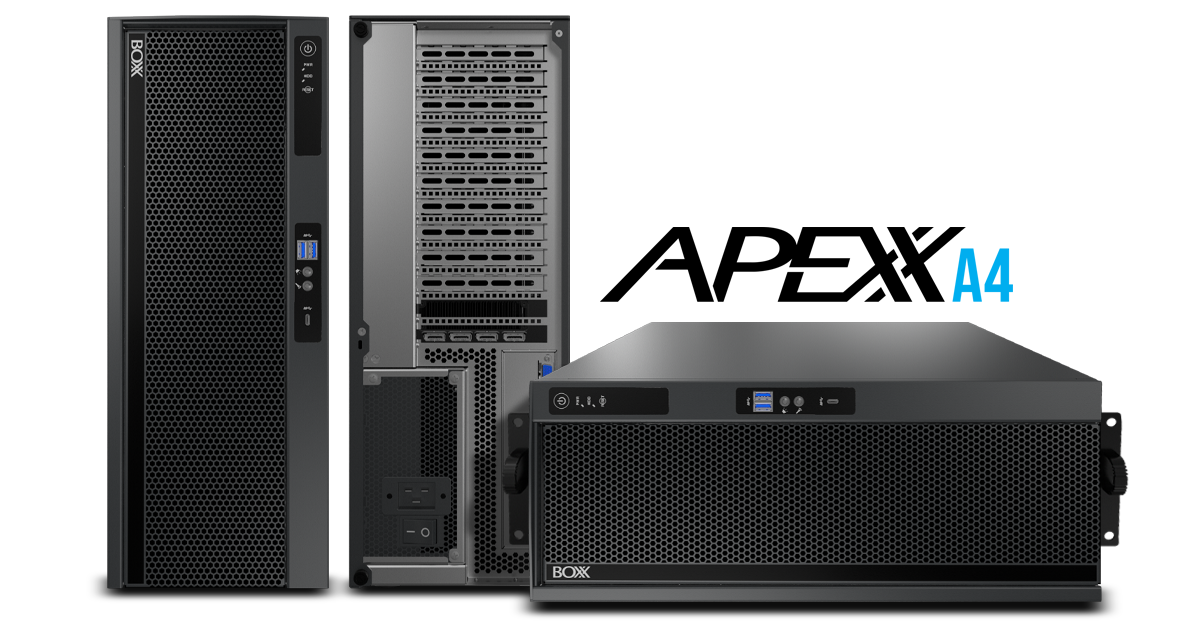
BOXX has launched the APEXX A4 Workstation, powered by AMD Ryzen 9000 Series processors and NVIDIA RTX PRO GPUs, designed for demanding 3D content creation and rendering workflows. This new system starts at $5,931 and is aimed at professionals in media and entertainment, architecture, and design industries. The workstation supports high-performance tasks critical for pre-production and post-production in streaming media.
Key Takeaways
- Powered by AMD Ryzen 9000 processors with 16 cores and 32 threads using Zen 5 architecture.
- Supports professional-grade NVIDIA RTX PRO GPUs and up to 256GB of DDR5-5600MHz memory.
- Storage configuration includes four 3.5-inch bays and three M.2 NVMe slots for high-capacity production data.
- The 1,200-watt power supply and rackmount option cater to both deskside and server-room deployments.
- Entry-level configuration starts at $5,931 with an NVIDIA RTX PRO 2000 Blackwell GPU.
Why It Matters
The introduction of the APEXX A4 addresses the escalating compute requirements for pre-production and post-production in the streaming sector. By incorporating the Zen 5 architecture, BOXX provides a direct performance path for 8K rendering and complex visual effects that are now standard in premium OTT content. This launch challenges market incumbents like Dell by offering specialized, liquid-cooled configurations that maximize clock speeds beyond standard enterprise limits. As streaming platforms increase their reliance on photorealistic 3D assets for marketing and virtual production, high-frequency workstations become critical infrastructure. Watch for AMD's continued market share gains in the professional segment as media studios prioritize many-core efficiency and PCIe 5.0 throughput for localized AI and rendering workloads.
Additional Context
The launch of the APEXX A4 coincides with a broader rollout of AMD’s Ryzen 9000 series, which officially hit the retail market in August 2024. According to TechRadar (June 2024), the Zen 5 architecture provides an estimated 16% improvement in instructions per cycle (IPC) over the previous iteration, directly benefiting single-threaded tasks common in 3D modeling software. This hardware refresh is vital for the media and entertainment sector, which processed over 27 petabytes of rendering data monthly as of May 2026, per Business Research Insights. The demand is largely driven by streaming platforms requiring increasingly complex animated content and high-fidelity visual effects. On the graphics front, the workstation utilizes NVIDIA’s Blackwell-based RTX PRO series. Per Tom’s Hardware (June 2026), these GPUs have faced significant pricing volatility due to a global shortage of GDDR7 memory and surging AI demand. The flagship RTX PRO 6000 Blackwell saw its official marketplace listing increase to $13,250, a 55% jump from its March 2025 launch price. Despite these costs, the 96GB VRAM capacity remains a gold standard for studios running large-scale AI models and 8K simulation locally. Concurrent market analysis from Fortune Business Insights (May 2026) projects the global 3D rendering and visualization software market will grow at a CAGR of 19.9% through 2034. While cloud-based rendering is expanding, on-premise systems like the APEXX series still account for approximately 43% of implementation demand due to the latency requirements of collaborative 3D workflows. Performance specialists note that BOXX’s strategy of liquid-cooling consumer-grade chips like the Ryzen 9000 allows for higher sustained boost clocks than many competing enterprise workstations, making them a preferred choice for studios like those mentioned by Jon Peddie Research (August 2024) utilizing Autodesk Maya and Cinema 4D.
Read full article at boxx.com