

Boxx HELIXX 2U4G launches with Intel Xeon 6700 for edge AI
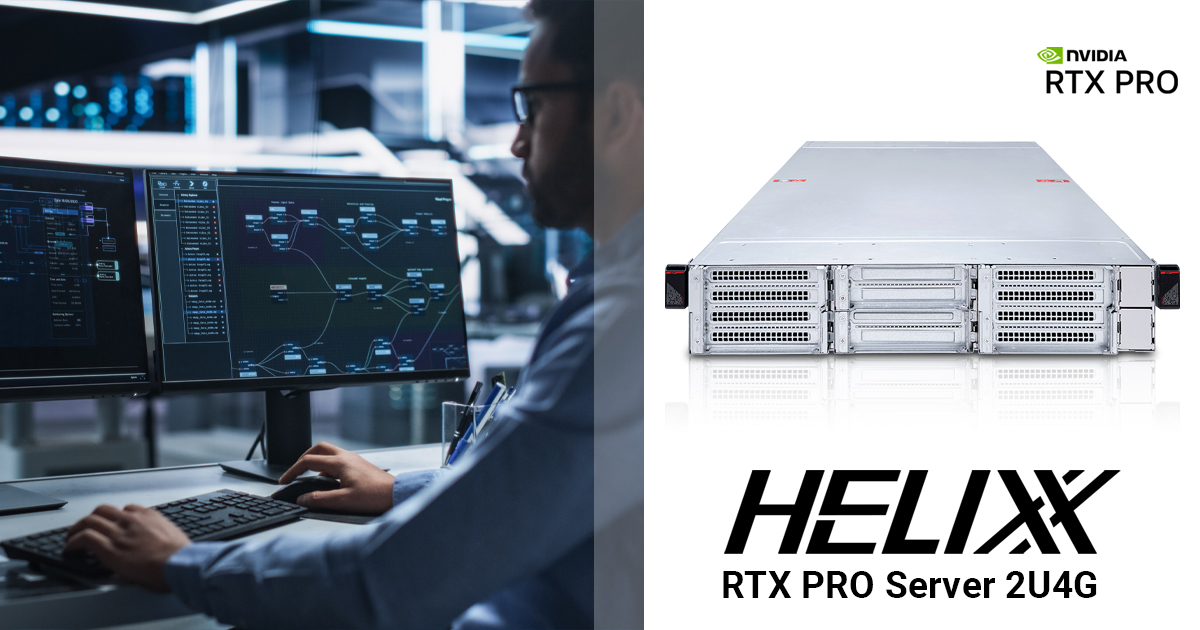
Boxx has launched the HELIXX 2U4G server, a high-density 2U server powered by Intel Xeon 6700 Series processors. It supports up to four graphics cards and 2 TB of memory, making it ideal for NVIDIA Omniverse simulations and high-performance edge AI inference. The compact server is designed to deliver necessary GPU, CPU, and memory resources for real-time rendering and AI model deployment.
Key Takeaways
- Supports up to four NVIDIA RTX PRO 6000 Blackwell Server Edition GPUs via PCIe 5.0 x16 slots
- Powered by Intel Xeon 6700P processors featuring 64 cores and 128 threads with a 4.0 GHz boost clock
- Maximum configurable memory of 2 TB DDR5-6400MHz across 16 DIMM slots
- Equipped with a 2400-watt 2+2 redundant 80 Plus Titanium power supply to support dense GPU configurations
Why It Matters
The HELIXX 2U4G addresses a critical shift as AI workloads pivot from centralized training to distributed edge inference. By packing four Blackwell-class GPUs and 2 TB of RAM into a 2U chassis, Boxx provides the high-density compute required for low-latency video analytics and photorealistic digital twins. In a market where 2026 inference compute is projected to be two-thirds of all AI activity, this density allows streaming and production firms to deploy heavy rendering workloads outside traditional mega-DCs. Watch for broader adoption of these high-density nodes as organizations seek to bypass the current power-availability bottlenecks affecting Tier 1 hyperscale facilities.
Additional Context
The launch of the HELIXX 2U4G coincides with a major transition in datacenter architecture. Per Gartner in May 2026, worldwide AI infrastructure spending is projected to hit $2.59 trillion this year, with a significant shift toward inference. Training workloads historically utilized a 1-to-8 CPU-to-GPU ratio, but the rise of real-time agentic AI and complex reasoning pipelines is moving the industry toward a 1-to-1 ratio. This shift has exhausted factory allocations for high-core-count processors, making high-density units like the HELIXX, which balances 64-core Xeon 6700P power with quad-GPU support, critical for enterprise availability. Intel's Xeon 6700P, introduced in mid-2025, was specifically designed to bridge the gap between efficiency-core models and high-end HPC silicon. Per Telecompaper in February 2025, the Xeon 6 series delivers double the AI processing capacity and 2.4 times the RAN capacity over the previous generation. Critically for the streaming sector, these chips include an integrated Media Transcode Accelerator, which Intel claims provides a 14-times performance-per-watt improvement over 2023-era silicon. This hardware acceleration is vital as AI-optimized servers are forecast to consume 31% of total datacenter power by the end of 2026, according to June 2026 Gartner reporting. Market demand is also being driven by the NVIDIA RTX PRO 6000 Blackwell Server Edition. Released in March 2025, each GPU features 96 GB of GDDR7 memory and 5th-generation Tensor Cores. Per NVIDIA technical documentation, these units provide up to 3x the AI performance of the previous Ada Lovelace generation. The combination of high-density chassis and GDDR7-equipped GPUs allows local processing of massive models like Llama-3 70B on a single card, effectively turning edge servers into high-fidelity nodes for virtual production and real-time broadcast analytics.
Read full article at boxx.com