

BOXX launches high-density server with eight NVIDIA Blackwell GPUs
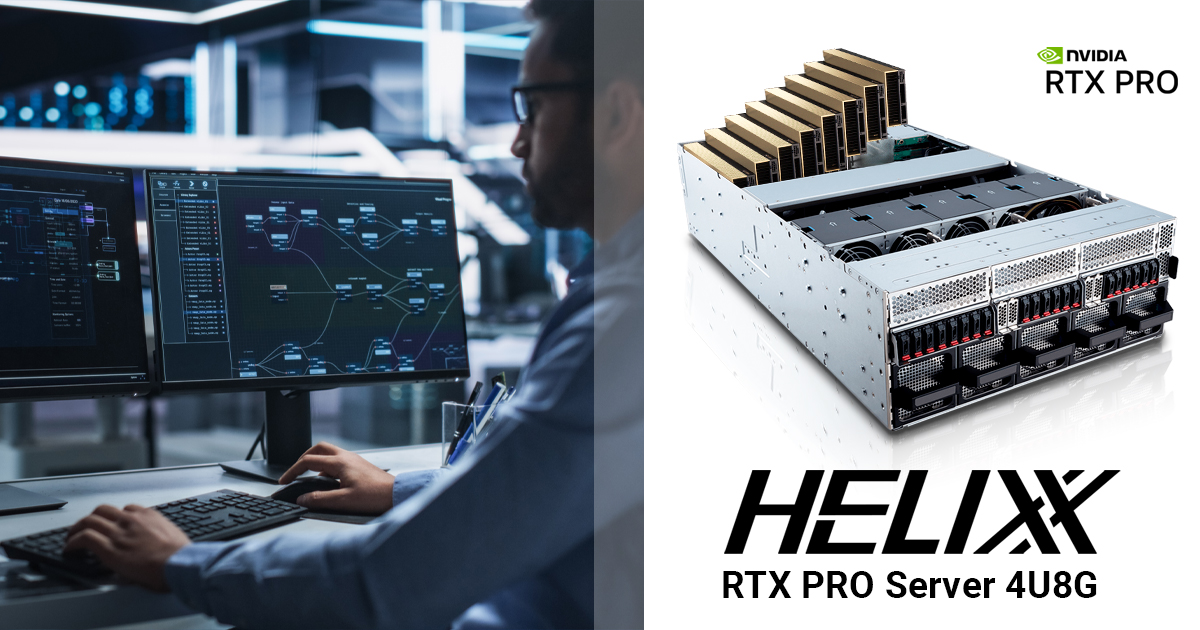
BOXX has introduced the HELIXX 4U8G | XEON, a high-density 4U server powered by dual Intel Xeon 6700 Series processors and supporting up to eight NVIDIA RTX PRO Blackwell Server Edition GPUs. This server is designed for deploying NVIDIA Omniverse simulations, high-performance LLM inference, real-time rendering, and AI model deployment. The product provides significant GPU, CPU, and memory resources in a compact design for edge deployments.
Key Takeaways
- Supports up to eight NVIDIA RTX PRO Blackwell Server Edition GPUs with a 4800W power budget
- Powered by dual Intel Xeon 6700 Series processors with up to 128 cores and 256 threads
- Accommodates up to 4TB of DDR5-6400MHz memory across 32 DIMM slots
- Provides 20 hot-swap E1.S drive bays and dual M.2 slots for high-density storage
- Features a compact 4U chassis designed specifically for edge deployments and local AI factories
Why It Matters
The HELIXX 4U8G provides the extreme compute density required for real-time generative AI and large-scale rendering at the edge. As streaming platforms shift away from expensive over-provisioned cloud instances toward hybrid infrastructure, high-density on-premises servers offer a predictable cost model for resource-heavy workloads like 8K video transcoding and virtual production. This launch solidifies the role of specialized hardware in localizing AI inference, reducing latency for automated content personalization and real-time metadata tagging. Watch for adoption rates among Tier 1 broadcasters and VFX houses seeking to leverage Blackwell-class performance without moving their entire IP library to public cloud environments.
Additional Context
The release of the HELIXX 4U8G coincides with a strategic shift in the streaming and data center sectors toward cost optimization and workload localization. Per Broadpeak (February 2026), streaming platforms are increasingly diversifying their technology stacks away from hyperscale cloud providers to reduce unpredictable monthly bills, marking a shift toward hybrid infrastructure. This trend is driven by high-bitrate demands; 4K streaming requires at least 20MB/s, while emerging 8K video mandates 60-90MB/s, placing immense pressure on physical edge infrastructure. Simultaneously, Intel and NVIDIA have refreshed their enterprise portfolios to support these high-density requirements. Per Intel (February 2025), the Xeon 6700 series was designed to deliver 1.4x better performance than previous generations, specifically serving as a foundational host node for multi-GPU AI systems. NVIDIA launched the RTX PRO 6000 Blackwell Server Edition in mid-2025 to accelerate the transition from CPU-only systems to accelerated computing, claiming up to 45x better performance for traditional workloads like simulation and video processing compared to legacy 2U hardware (per NVIDIA, August 2025). By June 2026, industry reports from CDNetworks suggest that the global market for streamed content has exceeded $670 billion, making infrastructure a key competitive differentiator (per CDNetworks, January 2026). As AI-driven personalization and real-time interactivity move from experimental to core operations, high-density servers like the HELIXX line are becoming essential for managing the sheer scale of the 2026 digital media economy, which must now balance rapid generative AI growth with rigorous operational efficiency and margin sustainability.
Read full article at boxx.com