

BOXX targets VFX market with new Blackwell-ready APEXX and RAXX workstations
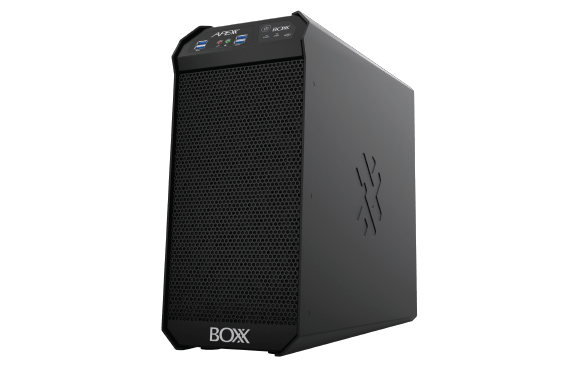
BOXX Technologies offers GPU rendering workstations, including APEXX desk-side and RAXX rack-mounted systems, designed to accelerate 3D modeling, animation, and VFX for creative professionals. These systems feature AMD Threadripper and Intel Xeon processors and support multiple GPUs for demanding rendering workflows. BOXX also highlights the benefits of network rendering, network render managers like PipelineFX Qube! and AWS Thinkbox Deadline, and compatibility with NVIDIA RTX-enabled software and the NVIDIA EGX Platform.
Key Takeaways
- APEXX T4 PRO-X supports up to four NVIDIA RTX PRO Blackwell GPUs with a dedicated 2050W power supply.
- RAXX T3 PRO rackmount systems feature up to 96 cores and 2TB of DDR5-6400MHz memory for high-density rendering.
- Workstations offer verified compatibility with NVIDIA EGX Platform for RTX-enabled software like OctaneRender and V-Ray.
- Integrated support for PipelineFX Qube! and AWS Thinkbox Deadline facilitates transition from local to network-based rendering.
Why It Matters
The shift toward real-time ray-tracing and AI-assisted rendering is forcing a hardware refresh across the production pipeline. BOXX’s immediate support for NVIDIA’s Blackwell architecture provides the computational density required for increasingly complex neural rendering and virtual production. As streaming platforms demand higher-fidelity CGI at faster release cadences, these workstations bridges the gap between local design and high-capacity network render farms. Watch for whether high power requirements for four-GPU configurations (up to 2050W) drive a broader shift toward liquid-cooled, rack-mounted infrastructure for standard editorial suites.
Additional Context
The launch arrives as NVIDIA consolidates its grip on the professional market. Per Tom's Hardware in June 2026, NVIDIA recently increased the price of its flagship RTX PRO 6000 Blackwell GPU by 55% over its launch MSRP, reflecting a global memory shortage and surging demand for AI workstation-class hardware. Despite these rising costs, research from Carbon Credits in early 2026 indicates NVIDIA holds roughly 92% of the discrete GPU market, maintaining a significant lead over AMD and Intel through its mature CUDA and RTX software ecosystems. In the broader rendering sector, the industry is pivoting toward hybrid ‘intelligent’ workflows. According to Business Research Insights, the global render farm market is expected to reach $0.6 billion by 2026, growing at 10-12% annually. This growth is driven by the integration of neural rendering techniques, such as 3D Gaussian Splatting, which can be up to 100 times faster than traditional path tracing. Superrendersfarm reported in late 2025 that roughly 30% of individual render jobs are now GPU-based, as AI denoisers and neural texture compression move from experimental features to production standards. Furthermore, the competition for the underlying processor architecture remains fierce. While BOXX highlights AMD’s 96-core Threadripper PRO 9000, Intel recently launched its Xeon 600 series to recapture market share in the simulation and technical compute segments. Per analysis from Counterpoint Research in August 2025, while AMD’s Ryzen PRO series offers strong multi-threaded performance for VFX, NVIDIA’s dominance in the GPU layer effectively dictates the hardware specifications for the majority of modern production pipelines.
Read full article at boxx.com