

Boxx debuts Helixx RTX PRO servers with NVIDIA Blackwell architecture
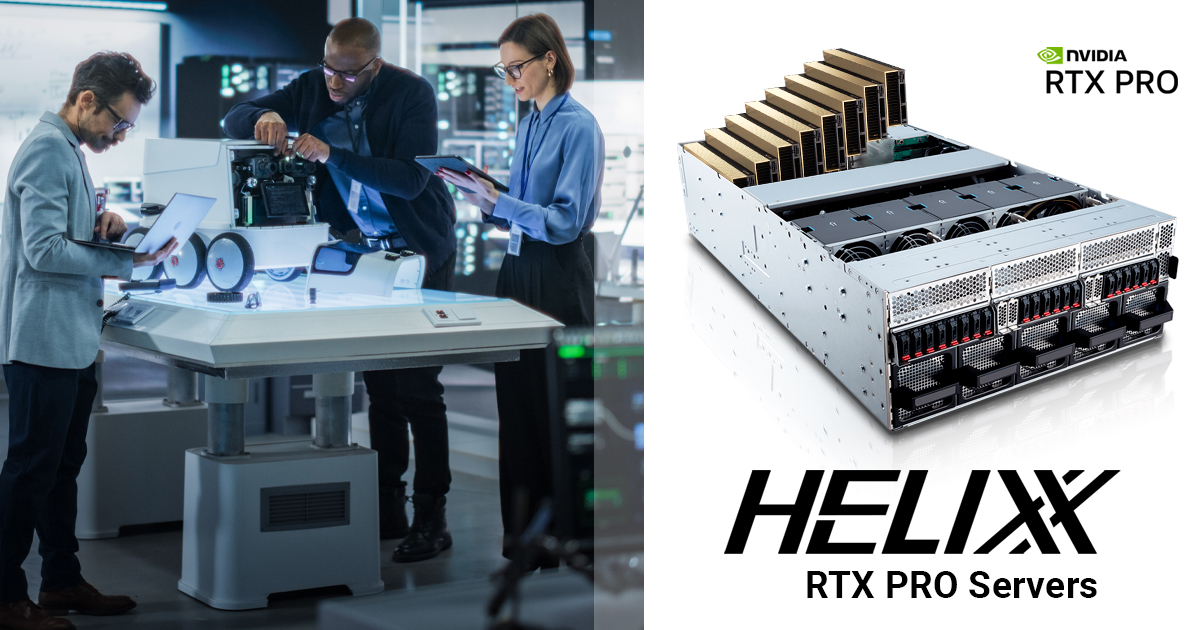
Boxx has introduced its new Helixx RTX PRO Servers, powered by NVIDIA Blackwell GPUs, designed to accelerate enterprise AI, HPC, and visualization workloads. These servers offer significantly higher performance and improved price-performance for on-premises AI development, including generative AI, digital twins, and visual computing. Configurations include up to eight NVIDIA RTX PRO 6000 Blackwell Server Edition GPUs and support high-bandwidth networking with NVIDIA ConnectX-8 SuperNIC technology.
Key Takeaways
- Supports configurations with up to eight NVIDIA RTX PRO 6000 Blackwell Server Edition GPUs and 4TB of DDR5-6400MHz memory
- Integrates NVIDIA ConnectX-8 SuperNIC technology providing up to 400 Gb/s networking with RDMA and hardware offloads
- Delivers reported 4.5x price-performance advantage in NVIDIA Omniverse real-time interactive rendering tasks
- Offers up to 5x better value for enterprise HPC workloads including genomics and scientific simulations over cloud counterparts
- Includes support for NVIDIA AI Enterprise and Omniverse platforms for on-premises AI factory deployments
Why It Matters
The release of Blackwell-based enterprise servers signifies a shift toward on-premises 'AI factories' for high-fidelity visualization and agentic AI development. By offering single-node clusters capable of massive throughput, Boxx provides a high-density alternative to cloud-based inference, which is increasingly hit by inventory shortages and latency. For the streaming industry, this hardware accelerates neural rendering and real-time virtual production, enabling more complex digital twins and automated media processing. As the market pivots from model training to large-scale inference and physical AI, the ability to maintain local IP control while scaling 8-GPU configurations will be a key competitive advantage. Watch for high-end production houses to transition from L40S-based racks to these higher-vRAM Blackwell nodes.
Additional Context
The launch arrives during a period of significant pricing volatility and supply constraints in the workstation GPU market. Per Gizchina in June 2026, the official price for individual NVIDIA RTX PRO 6000 Blackwell Workstation Edition GPUs has surged to $13,250—a 55% increase since its March 2025 debut. This price hike is largely attributed to a global shortage of 96GB GDDR7 memory, which remains a critical component for running 70B-parameter AI models locally. Analysis from Tom’s Hardware noted that 92% of the recent price increase is driven by pure market demand rather than manufacturing costs, as competitors have yet to match NVIDIA's VRAM capacity. Simultaneously, the broader data center landscape is shifting toward inference-heavy workloads. Per Gartner reporting in May 2026, worldwide AI spending is projected to reach $2.59 trillion this year, with AI infrastructure components accounting for over 45% of that total. Technical trackers from Dell'Oro confirm that inference now consumes roughly two-thirds of all AI compute, a significant rise from 2023 when training was the dominant load. This shift has forced OEMs like Boxx to redesign server architectures to support a 1-to-1 CPU-to-GPU ratio, necessitated by the orchestration requirements of autonomous AI agents. Energy infrastructure also remains a primary bottleneck for high-density deployments. Data from industry trackers like ServerMonkey indicates that power, rather than silicon availability, has become the 'hard ceiling' for data center expansion in mid-2026. This has increased the value of power-efficient architectures like Blackwell, which reportedly use 18x less energy than CPU-only solutions for comparable AI tasks, according to InsightAce Analytic reporting from March 2026. NVIDIA has reinforced this enterprise focus by launching its 'ACIE' (AI Clouds, Industrial, and Enterprise) reporting sub-market to better track these high-growth infrastructure deployments.
Read full article at boxx.com