

Fox Sports Centralizes 2026 World Cup Workflows via Distributed IP Hubs
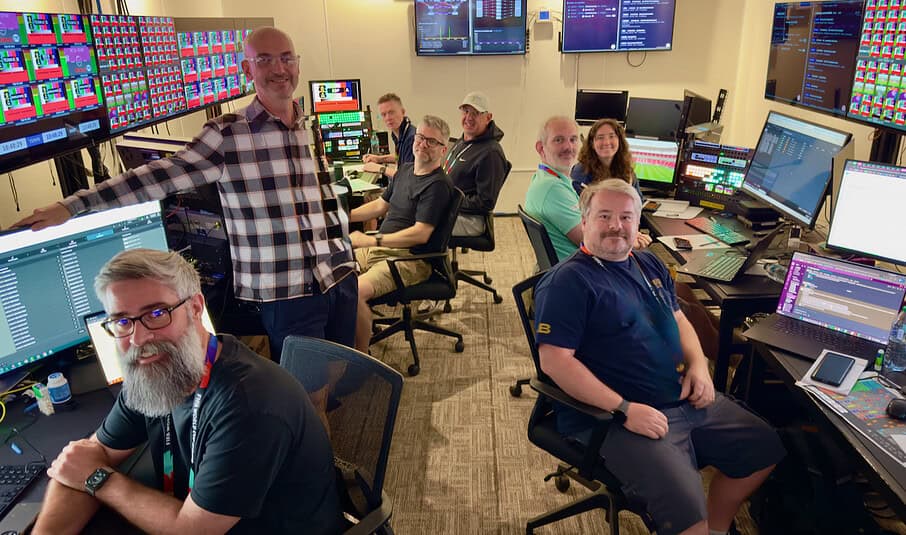
FOX Sports is centralizing its 2026 FIFA World Cup operations in Los Angeles, using a Dallas-based IBC and remote production workflows. This setup leverages Appear X20 encoders for JPEG-XS and HEVC signal transport over a diverse 100 Gbps network to Pico and Tempe, ensuring resilience and efficiency for live production and disaster recovery. They also deployed custom-built BRISK remote IP studio kits, Arista IP backbones, and Calrec audio processing, with Grafana for network monitoring to manage complex signal flows across multiple sites.
Key Takeaways
- Fox is deploying 60 JPEG-XS and 26 HEVC paths using dual 100 Gbps diverse circuits connecting Dallas, Los Angeles, and Tempe.
- The 2026 production uses native 1080p HDR at 59.94 fps, eliminating the need for LUT or frame rate conversion.
- Custom-built 'BRISK' (Broadcast Remote IP Studio Kit) flypacks enable 8-to-12 camera remote setups that connect directly to LA control rooms.
- Network resilience is managed via SMPTE 2022-7 and Grafana monitoring, allowing automatic traffic rerouting through Tempe if fiber paths fail.
Why It Matters
Fox Sports is standardizing the transition from on-site production to high-scale REMI (Remote Integration Model) for premier global events. By moving heavy production to a home base while maintaining a technical footprint at the IBC, Fox reduces physical overhead without sacrificing signal reliability. This architecture demonstrates the maturation of JPEG-XS over wide-area networks (WAN) and SMPTE ST 2110 for multi-site orchestration. Industry leaders will track if this centralized model can maintain sub-second latency across 104 matches, potentially setting a new blueprint for major tournament broadcasting. Success here would further marginalize traditional on-site production trucks in favor of permanent, high-capacity centralized facilities.
Additional Context
The 2026 World Cup represents a massive scaling of broadcast requirements, expanding from 64 matches in 2022 to 104 across 16 host cities in three countries. Per Fox Corporation, January 2026, the broadcaster plans over 340 hours of original programming, a 100-hour increase from the Qatar tournament. This expansion necessitated a modernized infrastructure; according to Appear, April 2026, Fox Sports selected their X Platform to unify remote production across its Home Run Productions (HRP) and Jewel Event systems. This allows the network to toggle between JPEG-XS for tier-one match feeds and lower-bandwidth HEVC/SRT for auxiliary content like fan reactions and press conferences. Simultaneously, the International Broadcast Center (IBC) in Dallas serves as the literal 'nerve center' for FIFA’s host broadcast services (HBS). Per TV Technology, June 2026, HBS provides the uncompressed shared foundation feeds that global rightsholders like Fox and Telemundo then augment. To handle the unprecedented volume, Fox is leveraging EVS Cerebrum and Arista 7508 switches to manage uncompressed ST 2110 traffic. This technical stack is also supporting new distribution channels; Fox announced in January 2026 that Tubi will simulcast the opening matches in 4K, marking a significant push into ad-supported streaming for premium live soccer. Beyond traditional broadcast, Fox is experimenting with immersive viewing via a partnership with Cosm. Per Cosm, May 2026, 40 tournament matches will be produced specifically for 'Shared Reality' venues in Los Angeles, Dallas, and Atlanta. These venues use 87-foot 12K+ LED domes to replicate pitch-side viewpoints, fed by the same high-capacity network infrastructure established for the primary broadcast. This multi-layered distribution strategy—spanning linear TV, Tubi, and immersive venues—relies entirely on the multicast-capable JPEG-XS WAN achievement credited to Fox's network engineering group.
Read full article at sportsvideo.org