

Moonshot AI launches open-weight Kimi K2.7-Code model with 30% efficiency boost
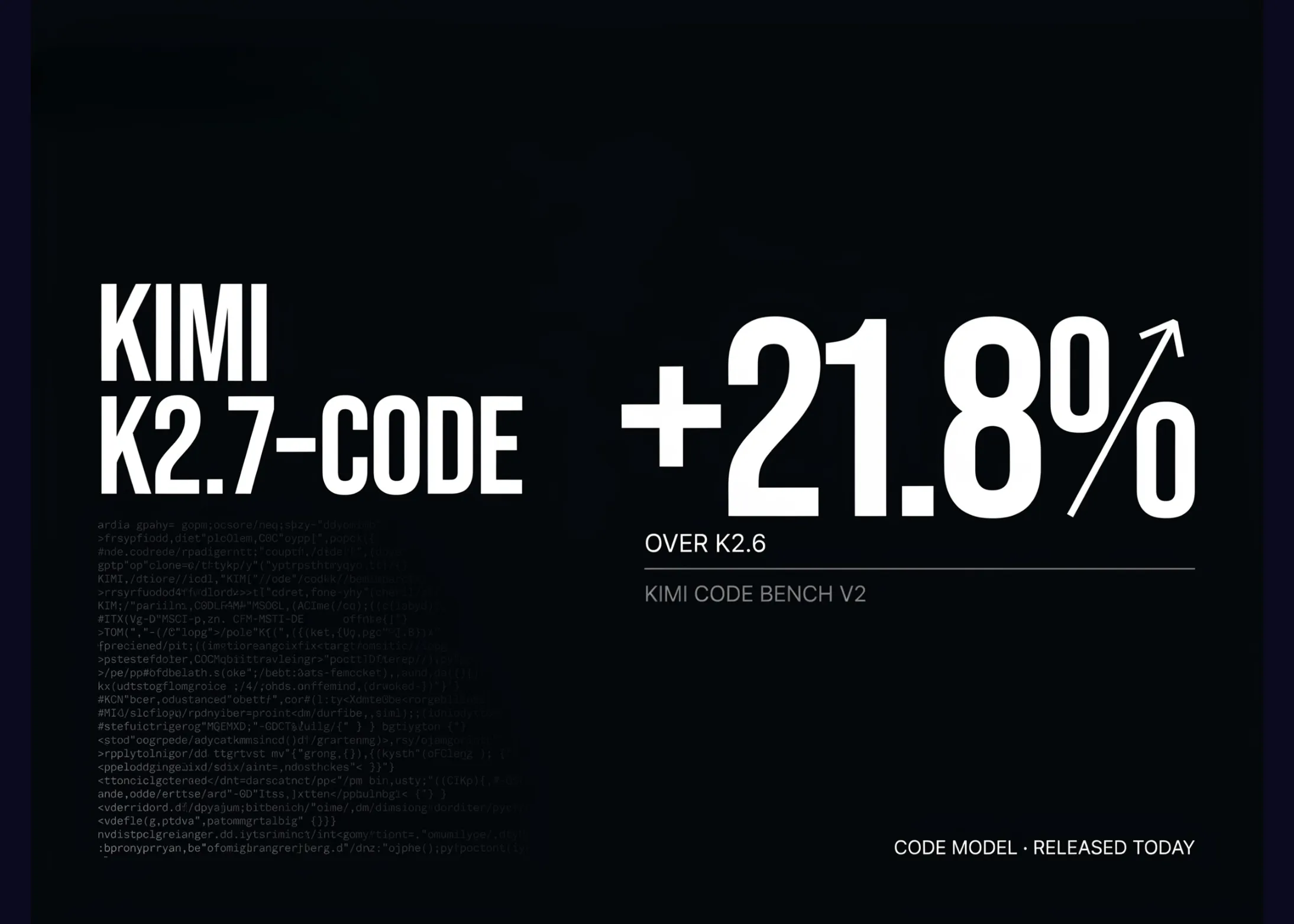
Moonshot AI has released Kimi K2.7-Code, an open-weight, agentic coding model under a Modified MIT license. This new model demonstrates significant performance improvements over its predecessor, K2.6, and reduces reasoning token usage by 30%, which could lead to lower operational costs for AI-powered coding tasks. It is designed for specific software engineering use cases like repo-scale refactors and code review, supporting both API access and self-hosting for server-class deployments.
Key Takeaways
- 1T-parameter Mixture-of-Experts (MoE) architecture activating 32B parameters per token across 61 layers.
- Mandatory 'thinking mode' reduces reasoning-token usage by 30%, lowering costs for long-horizon agentic tasks.
- 256K token context window supports video and image input via a 400M-parameter MoonViT encoder.
- Model weights are available on Hugging Face under a Modified MIT license, requiring 595 GB of disk space.
- Performance on MCP Mark Verified (81.1) surpassed Claude Opus 4.8 (76.4) in company-reported benchmarks.
Why It Matters
The release provides a high-capacity, open-weight alternative for engineering teams requiring self-hosted agentic capabilities. By reducing reasoning-token overhead, Moonshot lowers the financial barrier for complex, multi-step workflows like repository-wide refactoring and automated code review. This move intensifies competition in the specialized AI sub-sector dominated by closed models like GPT-5.5 and Claude. In the streaming context, these efficiencies facilitate the automation of complex pipeline adjustments and video metadata tagging through the model's native multimodal support. Watch for independent verification of the reasoning-token savings on leaderboards like LiveCodeBench to confirm the reported efficiency gains.
Additional Context
The launch of Kimi K2.7-Code follows a period of rapid expansion for Moonshot AI, which reached a $3 billion valuation in 2024 after securing $1 billion in funding from investors including Alibaba and HongShan. Per Bloomberg in May 2026, the company has increasingly pivoted toward specialized 'reasoning' models to compete with OpenAI's 'o' series. This strategic shift reflects a broader industry trend where developers prioritize 'compute-over-time' (inference-time reasoning) rather than just raw training scale. Moonshot's focus on the Model Context Protocol (MCP) also aligns with industry efforts to standardize how AI agents interact with external data sources and developer tools. Simultaneously, the open-weight coding landscape has become highly fragmented. Per TechCrunch in April 2026, competitor Qwen released its 480B parameter Coder model, which similarly targeted the balance between local hosting and multi-agent performance. While Kimi K2.7-Code offers a massive 1T parameter architecture, its 595 GB footprint limits it to enterprise-grade server clusters, highlighting a growing divide between 'laptop-ready' models and 'server-class' open-weight models. Market analysts at Omdia noted in June 2026 that high-context, multimodal coding models are becoming critical for media and entertainment firms looking to automate video QA cycles and localized asset management.
Read full article at marktechpost.com