

NVIDIA runs Cosmos 3 physical AI world model on desktop GPUs
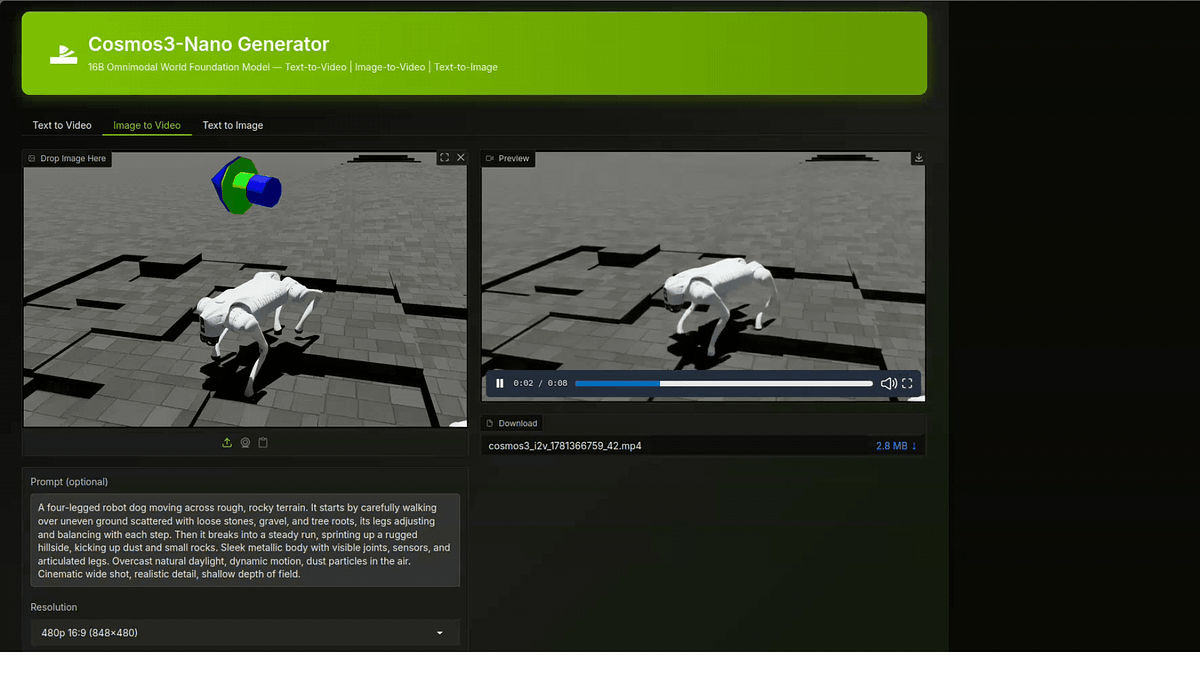
NVIDIA is demonstrating its Cosmos3-Nano omnimodal world model, released in June 2026, running via Docker on a single GB10 desktop GPU. This allows for unified generation of language, image, and video content within Docker containers for streaming professionals. The model, part of the Cosmos 3 family, processes and generates various media types in a single architecture, significantly reducing hardware requirements compared to the recommended 8x H100 GPUs.
Key Takeaways
- Cosmos3-Nano (16B parameters) generates unified language, image, and video content on a single desktop GPU.
- The model utilizes a Mixture-of-Transformers (MoT) architecture to combine scene reasoning with media generation.
- Hardware requirements are reduced from the enterprise-standard 8x H100 GPUs to a 128GB unified memory desktop system.
- Docker-based deployment allows for text-to-video and image-to-video generation without local Python or PyTorch installations.
Why It Matters
This development effectively democratizes 'world model' simulation by moving high-fidelity video generation from the data center to the developer workstation. For the streaming industry, this accelerates the creation of physically accurate synthetic environments and complex visual effects through a unified AI stack rather than fragmented pipelines. The shift to single-GPU local inference suggests a coming wave of on-set and edge-based AI tools that do not rely on expensive cloud compute. Monitor the adoption of the Cosmos 3 architecture by major VFX houses and virtual production startups using the open-source checkpoints.
Additional Context
NVIDIA officially launched the Cosmos 3 family at GTC Taipei in June 2026, positioning it as the first 'fully open omnimodel' for physics-based AI. According to NVIDIA's June 2026 announcement, the model was trained on more than 20 trillion multimodal tokens, enabling it to process vision reasoning and world generation simultaneously. Along with the release, NVIDIA established the Cosmos Coalition, an alliance featuring industry leaders like Runway, Black Forest Labs, and Skild AI to standardize open-world model development. Per The Elec in June 2026, the family scales from a 4B parameter 'Edge' model to a 64B parameter 'Super' variant intended for data center clusters. The GB10 hardware powering these demos represents NVIDIA's transition toward unified 'AI PCs.' Per Tom's Hardware in January 2026, the GB10 Superchip integrates 20 Arm-based CPU cores with a Blackwell-architecture GPU that supports up to 1 PetaFLOPS of FP4 performance for AI workloads. The system’s 128GB of LPDDR5X unified memory allows the GPU to access massive datasets without the bottleneck of traditional PCIe transfers, bridging the gap between consumer desktops and workstation-class performance. According to NVIDIA's technical documentation from May 2026, this memory configuration is specifically optimized to run models up to 200 billion parameters locally. Third-party testing by Artificial Analysis in June 2026 ranked the Cosmos 3 lineup as the leading open-source model suite for image and video generation, surpassing previous benchmarks in physical plausibility. The architecture’s 'Mixture-of-Transformers' design splits tasks between a 'Reasoner Tower' for scene understanding and a 'Generator Tower' for synthesized output. This dual-tower approach facilitates more complex multimodal tasks, such as generating synchronized audio or predicting physical trajectories, which researchers at Marktechpost noted in June 2026 could reduce AI evaluation cycles from months to days.
Read full article at medium.com